By Scotty E. Kirkland
The youngest child born to Monroeville, Alabama, attorney A.C. Lee and Frances Finch Lee arrived on April 28, 1926. They named her Nelle, a reverse spelling of her maternal grandmother’s name. Her middle name, which years later she would use for her byline, was an homage to Dr. Harper, a
local pediatrician.
The world knew precious little of Nelle Harper Lee in her first few decades. She left home in 1944, first for a brief stint at Montgomery’s Huntingdon College and then on to the University of Alabama. In Tuscaloosa, she wrote for campus publications and raised eyebrows for her sometimes nonconformist habits of dress and decorum. She left with an education, but too early for a degree, in 1949. She was 23 years old and determined to become a writer in New York City. “I do believe I can make a living at it,” she told her family. Time proved her quite correct.
Our National Novel
A long decade of writerly toil separated Lee’s Manhattan arrival and success. In 1956, two of Lee’s friends who recognized her talents, Michael and Joy Brown, presented her with a lifechanging Christmas gift: a yearlong stipend to “write whatever you please.” Lee took the Browns’ gift and returned it to us all with the 1960 publication of her Pulitzer Prize-winning To Kill a Mockingbird. Young narrator Jean Louise “Scout” Finch takes readers through Depression-era Maycomb, a thinly disguised version of Lee’s hometown, in a coming-of-age story about racial justice and fairness.
Writer Casey Cep says that Mockingbird “somehow managed to be both urgently of its time and instantly timeless…speaking in the register of the eternal.” We are charmed by the unmanaged childhoods of Scout, Jem and Dill, drawn to admire the quiet dignity of the mournfully condemned Tom Robinson, curious about reclusive Boo Radley, steadied by headstrong Calpurnia. Even mean old Mrs. Henry Lafayette Dubose wriggles her spiteful way into our hearts.
Then there’s Atticus. In her portrait of local attorney Atticus Finch, Lee created one of the great characters of modern American literature. “You never really understand a person until you consider things from his point of view,” Atticus tells his daughter Scout. At moments when it mattered the most, the principled attorney lived up to his own teachings.
The author soon saw her characters brought to life on the silver screen, through memorable performances by two young Alabamians portraying Scout and Jem alongside Gregory Peck, Robert Duvall and Brock Peters. People are perennially drawn to the film, as well as a popular stage play at theaters large and small, including an annual production in Monroeville.
Onto the scene decades later came Go Set a Watchman. Published in 2015 by HarperCollins in unrevised form, just as Lee had submitted it decades earlier. It was not Mockingbird’s sequel, but rather an earlier version that was set in the mid-1950s and told from the perspective of an adult Scout. When Lee submitted it, her editor Tay Hohoff suggested a rewrite focusing on the childhood flashbacks; Mockingbird was born. God bless editors.
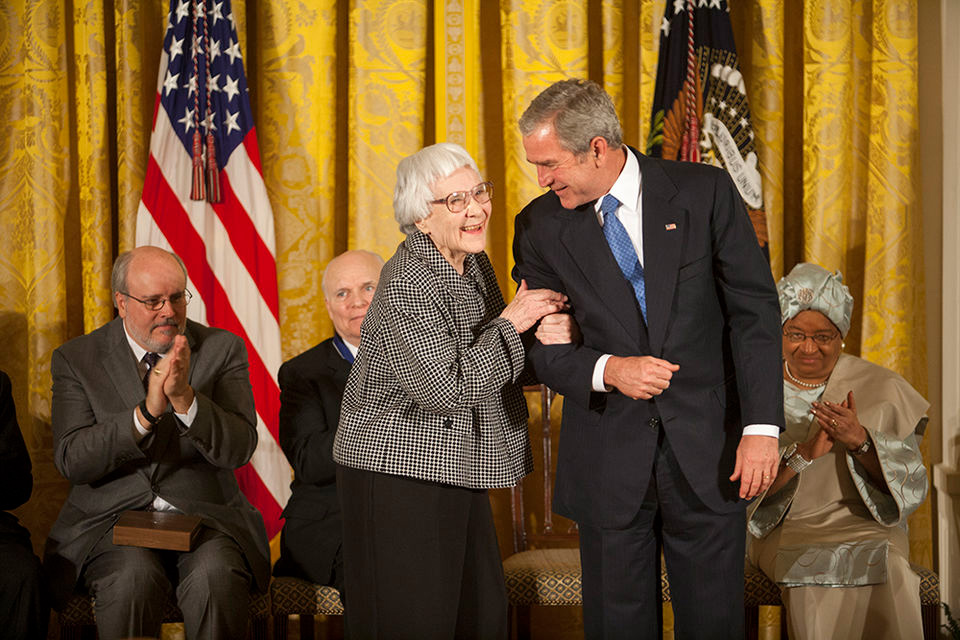
Since 1960, Mockingbird has sold more than 40 million copies and has been translated into dozens of languages. And yet, it is more than a mere book, a collection of some 360 pages. Oprah Winfrey once called Mockingbird “our national novel.” When he bestowed upon Lee the Presidential Medal of Freedom in 2007, George W. Bush said Mockingbird had “influenced the character of our country for the better.” Its simplicity helps keep it fresh in our minds, not unlike the songs or scriptures of our youth. It is elemental, eternal.
Owl in Daylight
A few scattered articles flowed from Lee’s pen in the years that followed. She labored on a second novel based on the real-life story of an Alabama minister accused of killing several family members. But the book never came. Years later, writer Casey Cep picked up that story in her own book, Furious Hours: Murder, Fraud, and the Last Trial of Harper Lee (Knopf, 2019).
Public events were few. In 1983, Lee reluctantly agreed to headline Eufaula’s History and Heritage Festival. Like a literary Woodstock, thousands would claim to have been in attendance. “I let my sister talk me into this,” she nervously proclaimed backstage, “and I feel like an owl out in daylight. Never again!” She avoided mockingbirds and Maycomb that day, delivering instead an appreciation of early Alabama historian Albert Pickett’s romantic prose. Pickett wrote history “composed of small dramas within a huge drama,” Lee said, leaving little wonder why she was drawn to his work.
“I am still alive, although very quiet,” Lee wrote to her agent a decade later. She traveled from Manhattan to Monroeville as she pleased. Quiet, yes; but content in it. Interview and speaking requests were generally refused. A stroke in 2007 brought Lee back to Monroeville for her life’s final chapter. Much of what we know from these years comes from eminent Alabama historian Wayne Flynt. In heartfelt books Mockingbird Songs (Harper, 2017) and Afternoons with Harper Lee (NewSouth, 2022), he recounts the long friendship he and his late wife Dartie shared with the writer. In those pages we see how thoroughly Lee lived out the words she wrote to a Mobile friend in the 1960s: “People who have made peace with themselves are the people I most admire in the world.” Nelle Harper Lee died in Monroeville on February 19, 2016, a few weeks shy of her 90th birthday, at peace with a world made better because she lived in it.
Now, a decade since her passing, readers are treated again to material from Lee’s hand. The Land of Sweet Forever (HarperCollins, 2025) is a small collection of previously unpublished stories written in the 1950s. Many await completion of an announced authorized biography by Casey Cep, which will assuredly draw from sources in the family’s possession. Like the knothole in the old oak where Boo Radley left his treasures, these closely held archives may soon offer additional glimpses into the life of one of Alabama’s greatest writers.
Still, if we never received another word from Lee, if the pens of her friends and biographers fell forever silent, what we are left with might still be enough: Her immortal characters. Her unchanging Maycomb.
Mockingbird’s ageless message, in the end, might be enough, indeed.