They were glorious, still beautiful after all these years in their red-and-gold bindings. They stood proudly, even if it was on the shelf of a thrift store. Most people under the age of 50 probably wouldn’t even know what they were, but I recognized them immediately.
That’s because when I was a kid, they were my Google, Gemini, ChatGPT, and Wikipedia. They were a middle-class status symbol. They were World Book encyclopedias.
A set of World Books contained basic information across a wide range of topics, arranged alphabetically. There were only 20 volumes, partly because certain paltry letters, like U-V, and X-Y-Z were combined into a single book.
Growing up, we had a complete set displayed proudly in a bookcase in the corner of our den. I had no idea where they came from or exactly when we got them. My guess is that my mother bought them in the early 1960s from a door-to-door salesman armed with a high-pressure pitch and a healthy dose of parental guilt about doing right by her four children.
They weren’t cheap. A full set cost around $180, almost $2,000 today, which made them one of the most expensive things in our house, right behind the television and the refrigerator. Fortunately, you could make manageable monthly payments of about $10 a month until the debt was finally paid off. I’m sure Mom bought them to help us with our schoolwork because my father wouldn’t spend that kind of money on books unless they included tips on improving your golf game.
Once I reached school age, they became an indispensable homework resource. It was as if we had a tiny library in our own home. If you needed to know something about almost anything like, volcanoes, Abraham Lincoln, or the mating habits of penguins, the answer was somewhere on that shelf. Of course, finding it required some effort: pulling out the correct volume, flipping through it, and hoping your younger sister hadn’t spilled mustard on the page you were looking for.
Naturally, they had their limitations. In order to keep the encyclopedias current, annual updates were required, updates Mom never quite got around to buying. As a result, some of our information was outdated. When I did a report on Alaska, for example, the World Book explained that soon it would become a state.
Looking back, World Books were a good investment because I read them constantly. Boredom often led to pulling one off the shelf and flipping through pages, discovering facts I hadn’t been looking for and didn’t particularly need, but somehow couldn’t stop reading. In my mind, this accumulation of random knowledge was going to pay off one day, hopefully on that new game show, “Jeopardy!”
Mom also supplemented our reference book collection by taking weekly trips to Kroger. That is not a typo. In the mid-60s, a low-end knock-off of World Book, called Golden Book Encyclopedias, was distributed in grocery stores throughout the country. Every week, a new volume showed up at the checkout, and if you spent 20 bucks on groceries, for 99 cents it could be yours.
That just didn’t seem right. After all, we don’t go to Barnes & Noble to pick up a gallon of milk. And I just can’t see my Dad saying to Mom, “Hey honey, when you head down to the store, make sure to get a bottle of ketchup, and bag of potatoes. And for God’s sake, don’t forget to pick up Volume G of the Golden Book. I’ve heard it’s full of golf tips.”
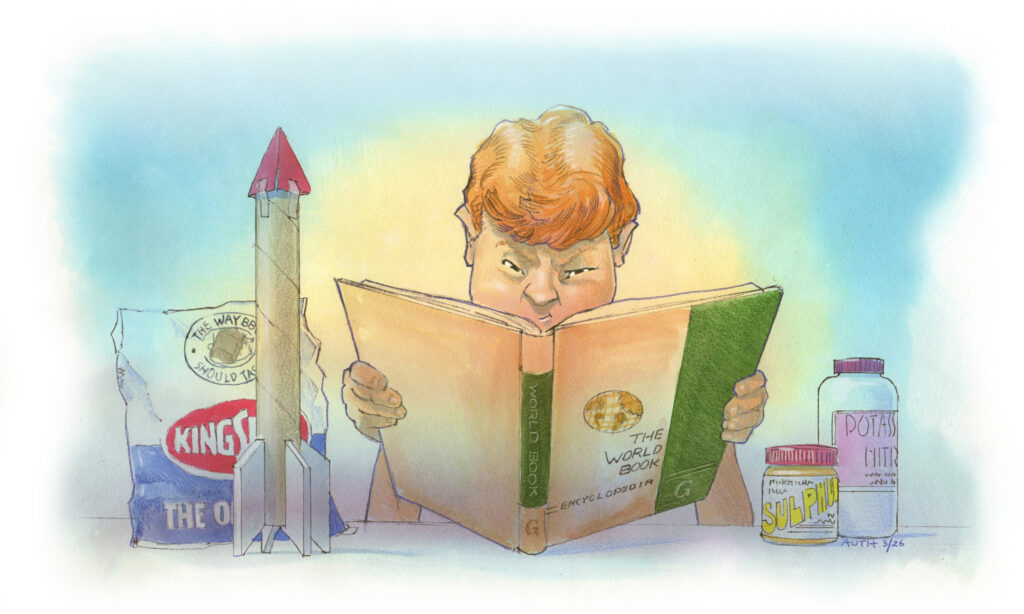
Like Google, encyclopedias allowed you to tumble down rabbit holes. At the time, my only interest was rockets and propulsion. By cross-referencing topics, I learned that the Chinese had invented crude rockets using gunpowder as a propellant. That discovery eventually led to the ingredients, and the proportions. Soon I was making gunpowder in the basement with drugstore supplies and charcoal from my dad’s grill, perfect for my clandestine backyard experiments with homemade missiles.
And now, years later, reference books have been replaced by a phone that fits in your palm. There’s a infinite amount of information available in seconds literally at our fingertips. That’s progress. I’m not ashamed to say that a lot of the background information on this column was sourced with the help of Google Gemini. Ironic? Yep.
But for all the access to information we gained, something has been lost. Sometimes I miss feeling of the weight of an encyclopedia on my lap and the anticipation of what was on the next page. The books didn’t buzz, beep or chirp. They just waited to help someone complete a project, or a curious kid with some time to kill.
Joe Hobby is a standup comedian, a syndicated columnist, and a long-time writer for Jay Leno. He’s a member of Cullman Electric Cooperative and is very happy now that he can use Sprout from his little place on Smith Lake. Contact him at [email protected].