By Allison Law
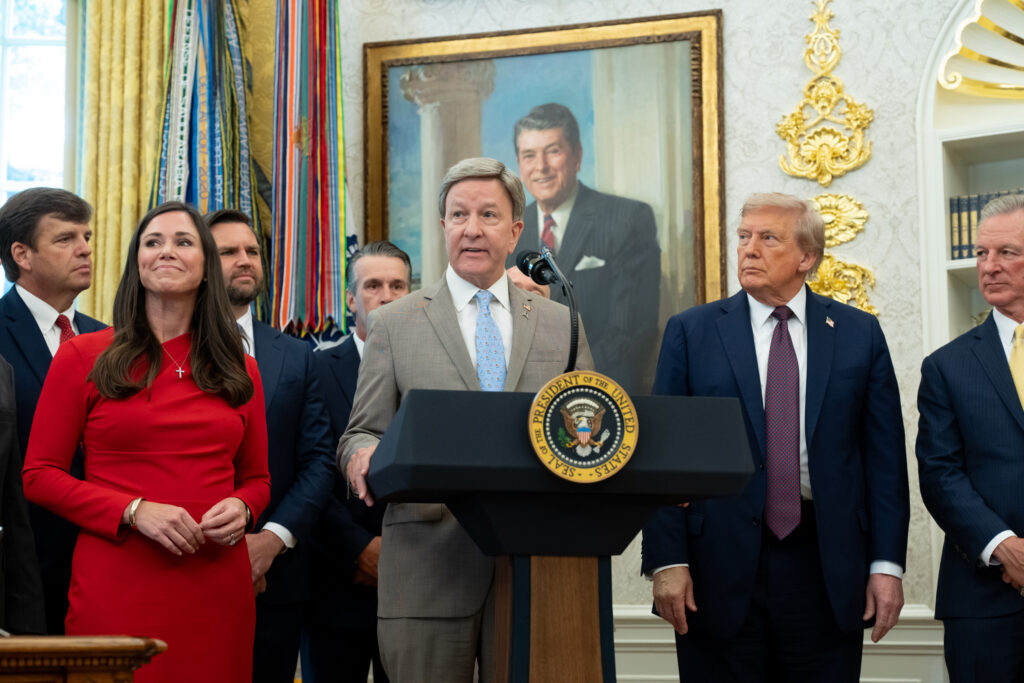
Many Alabamians don’t realize that one of our House members, U.S. Rep. Mike Rogers, holds a committee chairmanship with tremendous influence. Rogers, the chairman of the House Armed Services Committee since 2023, says it is, in his view, the most powerful committee in Congress.
“We authorize half of all discretionary spending,” Rogers says. Most people don’t realize that 80 percent of the (government) spending is on entitlement programs – Social Security, Social Security Disability, Medicare, Medicaid. Roughly 20 percent that Congress decides how to spend is called discretionary spending, and Defense makes up about 52 percent of that.
“My committee not only decides what we’re going to authorize with that 52 percent, but we actually pass a bill every year – the National Defense Authorization Act (NDAA). No other committee in Congress can point to five years, or even three years, of passing an authorization bill.”
Indeed, as of press time, the House had passed the final, negotiated NDAA fiscal year 2026, which was headed to the Senate. The White House issued a statement in December that the Trump administration “strongly supports” its passage.
His chairmanship of the committee is beneficial to the state, he says. “I’m just thrilled that I was able to stay here long enough to be elected chairman of it, since we’ve never had one from Alabama.”
A new kind of space race
Rogers could have run for the Senate several years ago but felt he had a “very real chance” to be the chairman of the House Armed Services committee. That may have been a prescient move; Rogers says, “we would not have been able to keep Space Command if we had not had the chairmanship.”
Space Command’s headquarters is currently in Colorado Springs, Colo., but this fall President Trump named Huntsville as the HQ’s permanent home. USSPACECOM or SPACECOM, as it’s often referred to, is one of 11 unified combatant commands within the Department of Defense and is responsible for U.S. military operations in space. It receives personnel and equipment from each of the military services.
Rogers’ interest in space militarization followed a circuitous route. He served on the Homeland Security committee, which he gravitated toward, before moving to Armed Services; that committee’s chairman asked him to take over the Strategic Forces subcommittee. Strat Forces, as it’s known, has jurisdiction over the nuclear arsenal, missile defense systems and the national security space. “While I was in that position, space was probably the one that least interested me, just because of the importance of nuclear systems and missile defense systems.”
As he became more familiar with those areas, it became apparent to him that “we had a real problem in space – it was becoming a warfighting domain.” China and Russia were building up their space capabilities, and Rogers felt “awakened” to how much space is integrated into our national security and our future. He and the top Democrat on the committee, Jim Cooper, developed legislation to create Space Force as a separate service, organized under the Department of the Air Force, in 2019.
“The evolution of warfighting (had) moved past the Air Force being the proper service for this mission,” he says. “It’s very popular.”
Working across the aisle
Rogers, a Calhoun County native who grew up watching national political conventions on TV, knew early on he’d go into politics. A lawyer and small business owner, he served on the Calhoun County Commission and was elected to Alabama House of Representatives in 1994, serving until 2002 when he was elected to Congress. In those many years, he’s learned a thing or two about what bipartisanship really means, and how to develop it.
“If you want to get something done, you have to work with the majority. In D.C., I’ve continued that. The lesson I’ve learned moving that process is, if you ever do anything meaningful – big legislation that matters – it has to be bipartisan,” he says. “I don’t care if you’ve got a majority and you’re in the majority, if it’s big, you can’t get it through with a straight line party vote. There are very few exceptions in my nearly 40 years of doing this.”
Having a good rapport extends to the Alabama delegation, he says, which is unique in that regard. “We’ve always worked closely as a delegation, and that is unusual up here. You’d be amazed at the delegations that don’t even talk to each other, much less get along.”
Building consensus, he says, is more than just Republicans vs. Democrats. “It’s not just the stuff across the aisle – this was true when I was in the Legislature too. It’s not a homogenous group. There are strata of Republicans, especially when you get to Washington. Our Republican conference could be divided into about five or six subgroups.
“You’ve really got to learn how to build consensus among those strata of subgroups within your conference, as well as reach across the aisle and get people you can work with.”
The meaning of compromise
For Rogers, compromising with people is not the same as compromising one’s values, though some voters may not see it that way.
“Up here, you’ve got to figure out how to get people to agree with you and get the herd to move with you.” Sometimes, that calls for a trade-off.
It’s also important to talk to the folks “back home,” he says, to make sure they understand the trade-offs. “Ronald Reagan had no problem cutting deals with the other side. His view was, if I can get 80 percent of what I want, and all I’ve got to do is get the other 20 percent, I’ll take that deal every time. When you go back home and talk to folks and explain that, they get it. They’re not stupid.”
There are some “knuckleheads” in his district who have a much more rigid philosophy, he says, where it’s their way or no way. “I don’t share that approach.
“I’m pretty hard core on social issues, like pro-life … Beyond that, I’m a pragmatic conservative. It’s not hard to make that work.”