The Endangered Watercress Darter’s Story is No Big Fish Tale
Story & Photos Nick Thomas

As a 24-year-old graduate student studying biology at the University of Alabama during the 1960s, Mike Howell made a discovery that most animal and plant researchers only dream of — he identified a new species.
Howell’s find, a small darter fish, might have been destined for notoriety only in the pages of scientific journals. But the brilliantly colored fish he named the watercress darter was found to only inhabit a handful of springs in Jefferson County — and nowhere else on the planet.
Like some scientific breakthroughs, luck played a role in the discovery of the new fish — one of more than 100 known darter species in the U.S. and sometimes referred to as the hummingbirds of the fish world due to their small size, colorful markings, and rapid darting movements. But serendipity, combined with Howell’s scientific training and curiosity, not only advanced his career (he went on to make groundbreaking discoveries in fish genetics while working at Samford University before retiring) but stimulated the community’s interest in the newly discovered tiny aquatic dweller.
“I had a professor, Ron Brandon, who was studying salamanders, and one day he returned to the lab from Glenn Springs in Bessemer after collecting samples with a dip net,” recalled Howell, referring to a large net that’s dragged through the water to collect random aquatic animal and plant samples. After pouring the collected water into a large container and removing the salamanders, Howell — who was actually studying darter fish for his Ph.D. thesis — noticed a lone fish remained, flapping around in the residual water.
“I asked Dr. Brandon if I could have the fish to study and it turned out to be an unknown darter species,” Howell says. Experts confirmed the finding, and said that Howell should classify the fish, name it and publish the results.
Since the fish were collected from a spring where watercress grew, the name seemed a suitable link to the fish’s habitat. Howell also discovered the darter in other springs around Birmingham including Thomas, Roebuck, and Seven Springs. As Howell wrote in his 2023 book, The History of Birmingham’s Endangered Watercress Darter, the fish is currently listed by the International Union for Conservation of Nature as “endangered.”
Just 1 to 2 inches long, the males are specially colored with distinctive patches of bright red, orange and blue. Because the minnow-like fish is small, agile, and elusive — rapidly retreating to the safely of watercress “forests” if disturbed — it can be difficult to observe directly in the water. This didn’t prevent a Birmingham church from “adopting” the almost invisible little fish.

Protecting God’s creatures
Seven Springs traverses property on Birmingham’s southwest side owned by Faith Apostolic Church. The church leaders, including the late Bishop Heron Johnson, established a community ecoscape — a term combining “ecology” and “landscape” — as a meditation garden to recognize and protect the small creature they had unknowingly shared their land with for decades.
“The church leadership embraced an idea put forward by famed biologist E.O. Wilson, a University of Alabama graduate, that science and religion could work together to protect the environment,” Howell says. “His argument was if you believe in God and that God created all the animals and plants, including the darters, shouldn’t you protect them if they are in danger? The bishop said if God put the darters in the springs He must have had a reason and resolved the church would protect them. And they still are today.”
On the other side of the city, in the East Lake neighborhood, a massive 15-by-30-foot colorful mural was painted on the side of a bookstore at 7769 2nd Ave. South in 2015 by Oregon artist Roger Peet, in conjunction with local artists, further raising awareness for the watercress darter. The painting was one of several that Peet’s Center for Biological Diversity Endangered Species Mural Project created to highlight endangered species around the U.S.
The colorful darter has also been honored by a spring city festival, beginning in 2011 and continuing today. Darter Fest promotes environmental awareness with its watercress darter mascot and provides funds for Birmingham City Schools education programs. A local beer company, Avondale Brewing, even produces a seasonal darter beer available at the festival.
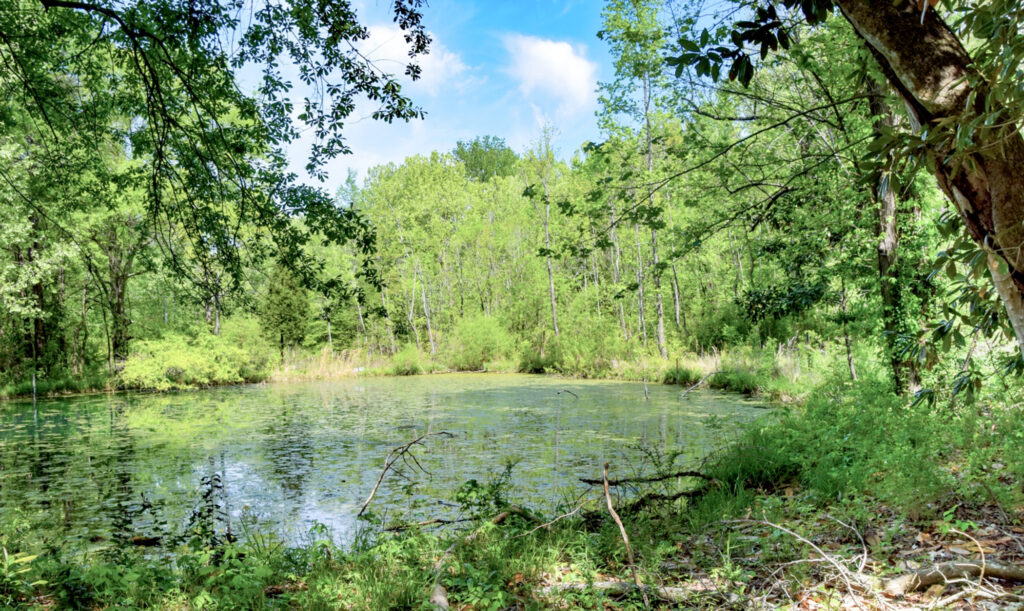
But perhaps the best recognition of the darter’s significance was the creation of the Watercress Darter National Wildlife Refuge at Thomas Springs. The 25-acre area is one of the smallest of the country’s 570 National Wildlife Refuges managed by the U.S. Fish and Wildlife Service (the smallest being the 0.57-acre Mille Lacs NWR in Minnesota). When Howell visited the Refuge with this writer this past spring, the area was clearly in need of maintenance but was nevertheless a reminder that nature is worth preserving for future generations.
“The watercress darter population is only found in five springs around Birmingham, an area that is highly populated and industrial, so any environmental contamination could significantly reduce the population,” Howell says. “Every living creature is unique and worth protecting if we can.”