Periodic moving keeps waterfowl guessing in late season
By the time migrating waterfowl reach Alabama, they know how to spot anything out of the ordinary. To fool ducks later in the season, sportsmen need to keep mobile.
Growing up hunting on public land, we set up in a different place each time. We tried to find spots with natural cover that ducks see all the time where we could hide. Unfortunately, good hunting spots don’t always come with excellent blind material.
As a kid, I experimented with various portable blind ideas. First, I split open several burlap sacks and nailed them to wooden sticks. They absorbed tons of water until they collapsed around me.
Next, I created a portable blind by stapling several camouflaged raincoats to sticks and placed the sticks around me for total concealment. Although, I thought the concept rather ingenious, the woodland green camouflage did not blend well with brown marsh grass where I hunted. Moreover, it certainly didn’t hide me when my father discovered what happened to his raincoats!
Many waterfowlers hunt from roomy permanent blinds. These big spacious blinds make hunting more comfortable, but birds in an area long enough quickly learn to recognize and avoid these permanent structures, especially later in
the season.
On most public lands like wildlife management areas, sportsmen can’t built permanent structures. Fortunately, sportsmen today can buy a variety of quick duck blinds or materials to make them so they can more easily keep up with the birds.
For decades, soldiers used camouflaged netting to hide their artillery and other vital assets from the enemy. When they moved to another position, they rolled up the nets. At the new location, they rapidly erected the nets to hide again.
Sportsmen can buy the same netting material in various camouflage patterns to make excellent blind material. Using a similar concept, although with much better materials than my earlier burlap sack or raincoat blinds and considerably less yelling, waterfowlers today can staple camouflaged netting to wooden stakes to make portable blinds.
Drive the stakes into the mud, wrap the netting around the spot and begin hunting in minutes at the chosen location. When sportsmen finish the hunt or wish to relocate, simply pull up stakes and leave, perhaps to re-erect the blind in another spot to take advantage of shifting winds and
duck movements.
Navigable waterways belong to the public, so people can hunt waterfowl from boats in practically any lake or river in Alabama unless otherwise prohibited. Adjacent lands might remain private, so don’t trespass.
In a state so filled with rivers and lakes, many waterfowlers hunt from small boats. With a small boat, sportsmen can scout for ducks, pick a spot, toss out a few decoys and begin hunting. If that spot doesn’t produce, they could motor to another location and try again. Some people might hunt two or three duck holes in a day.
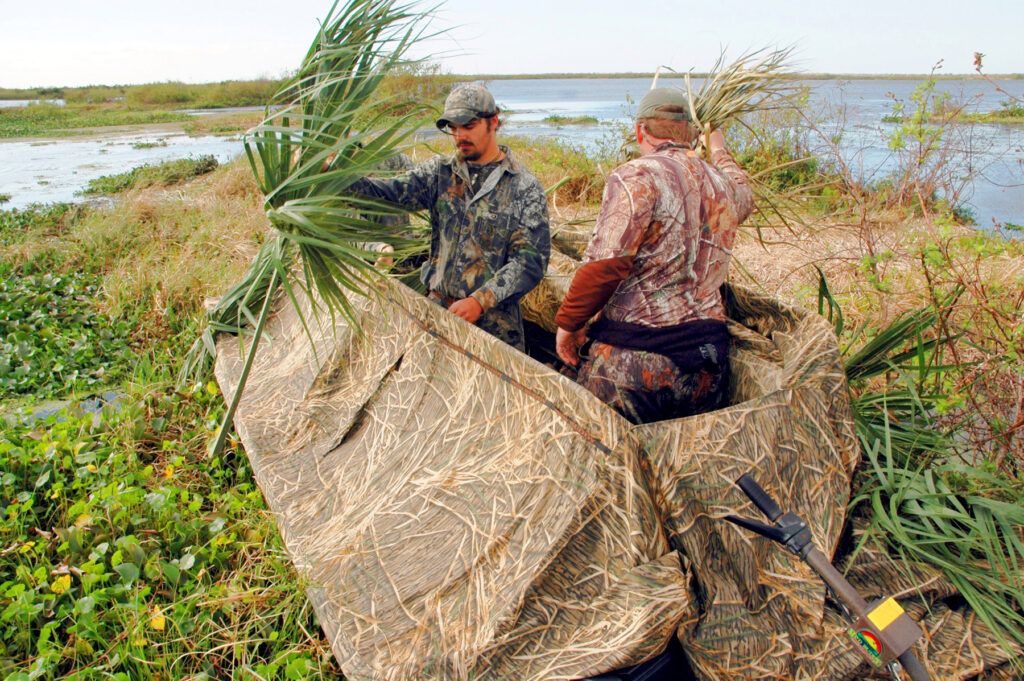
Some people simply run a small camouflaged boat into thick vegetation or hide it under overhanging branches for concealment. In some locations, Alabama sportsmen can add palmetto fronds, Spanish moss, tall reeds or other natural materials for additional camouflage.
Many people attach pop-up blinds to their boats. These come in varied camouflage patterns and materials. Most pop-up blinds come with two panels that resemble a pyramid when raised. As ducks come into range, drop a panel and begin shooting.
Some companies make various other portable blind options. Some look like gnarled old tree stumps, an excellent choice for hunting wooded shorelines along lakes or rivers. Others resemble haystacks, outstanding subterfuge for hunting in agricultural fields. The key, make any blind blend in with the natural surroundings so it looks like it belongs there.
Some better lakes for duck hunting include Aliceville, Demopolis, Eufaula, Guntersville, Pickwick and Wheeler. For rivers, the Black Warrior, Tennessee, Chattahoochee and Tombigbee-Alabama systems can also hold ducks. The Mobile-Tensaw Delta offers nearly 100,000 acres for public hunting. The marshy southern end attracts various duck species.
Other good WMAs include Barbour near Clayton, Coosa near Rockford, David K. Nelson near Demopolis, the Jackson County WMAs, Lauderdale near Waterloo, Lowndes near White Hall and Seven Mile Island
near Florence.
The late Alabama duck season lasts from Dec. 5 through Jan. 31. Youths, active-duty military and military veterans get a bonus day to hunt ducks on Feb. 7. All other laws and bag limits apply.
Regulations could differ on some public properties. For season dates and more information, see www.outdooralabama.com/seasons-and-bag-limits/waterfowl-season.
John N. Felsher is a professional freelance writer who lives in Semmes, Ala. He also hosts an outdoors tips show for WAVH FM Talk 106.5 radio station in Mobile, Ala. Contact him at j.felsher@hotmail.com or through Facebook.